- Image
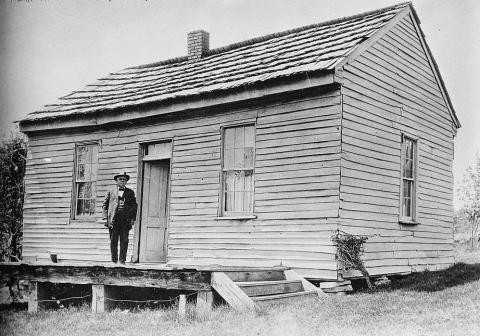
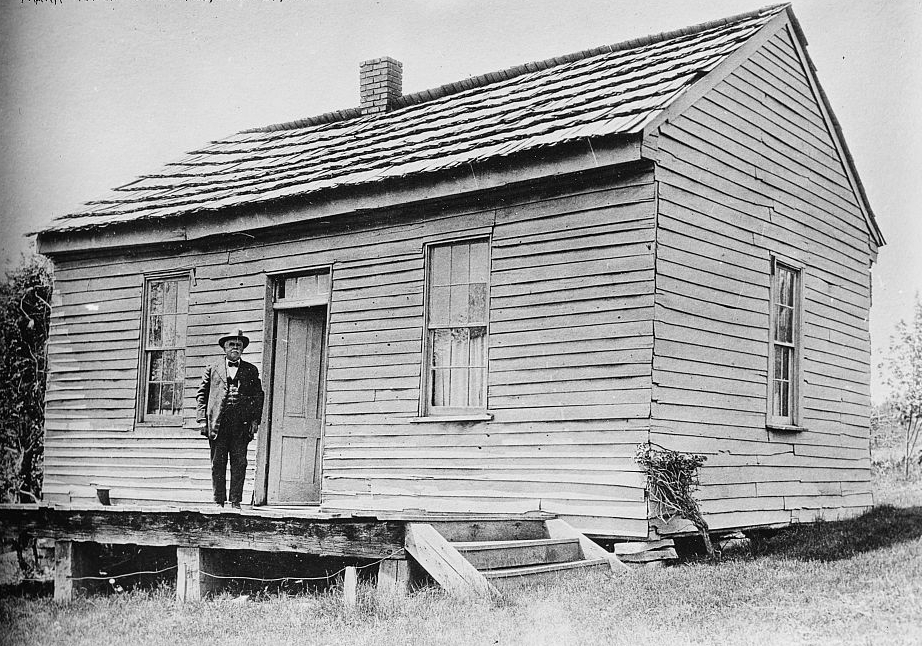
Samuel L. Clemens born 30 November 1835 in the village of Florida, Missouri.
The site of Florida, Missouri is located between what was the North and South Forks of the Salt River, now flooded by Mark Twain Lake. This was once within the homeland of the Osage Nation. The Treaty of Fort Clark, November 10, 1808, forced them westward. Forced even further west, they are now found in Oklahoma.
By 1818 the land along the Salt River was open for public purchase. The town of Florida was officially founded May 24, 1831 and town property was advertised for sale on April 16, in the Missouri Intelligencer, Columbia, MO. The ad said:
Lots for sale in the town of FLORIDA. The proprietors will offer for sale at public auction, on the first day of June next, a quantity of lots in the town of Florida, on a credit of six and twelve months; (purchasers giving bond with approved security.) Florida is situated on a ridge, half a mile from the junction, and immediately between, the North and South Forks of Salt River, Monroe County, MO., in the center of an extensive and fertile region of country, which at present embraces several good settlements, and from the tide of emigration, will, in a very short time be densely populated. From the local situation of Florida, few places in the interior of MO. possess equal advantages; Salt River is navigable for Keels, Batteaux, and Flat Boats, several months in the year, at the Forks; and arrangements have been made by the Legislature, for opening of the said river to the junction, which will make Florida the principal place of deposit for all the surplus produce raised within thirty or forty miles of said place. There are at present two good Grist, and one Saw Mill, (now in operation,) on each side, and within half a mile of the Cite (sic.); and yet enough water power to put in operation an immense quantity of machinery.
Florida being situated about 30 miles from Hannibal, Palmyra, and New London, and no probability of any Village being established between it and those places, must cause an extensive business to concentrate at said place.
Persons wishing to purchase Town property, will do well to call and examine for themselves.
By the winter of 1835-36. more than a third of the lots were sold and businesses established.
Around 1834, Benjamin Lampton, father of Jane Lampton (Sam’s mother), moved to New London, and later Florida, MO.. His daughter, Martha Ann (Patsy) had preceded him in the move to Florida with her pioneer husband, John Quarles, brother-in-law of Sam‘s father, John Marshall Clemens.
John Clemens was urged to move to Florida by John Quarles, then an established merchant, who expected the town to develop rapidly. There were twenty-one houses in Florida, but Quarles counted stables, out-buildings — everything with a roof on it — and set down the number at fifty-four.
Most of the houses were of logs—all of them, indeed, except three or four; these latter were frame ones. There were none of brick, and none of stone. There was a log church, with a puncheon floor and slab benches. A puncheon floor is made of logs whose upper surfaces have been chipped flat with the adze. The cracks between the logs were not filled; there was no carpet; consequently, if you dropped anything smaller than a peach, it was likely to go through. The church was perched upon short sections of logs, which elevated it two or three feet from the ground. Hogs slept under there, and whenever the dogs got after them during services, the minister had to wait till the disturbance was over. In winter there was always a refreshing breeze up through the puncheon floor; in summer there were fleas enough for all. (Twain’s Autobiography)
John Clemens, his wife, Jane, four children (Orion, Benjamin, Pamela, and Margaret), and Jennie, a slave girl, left Tennessee by a two-horse barouche and two extra horses to Louisville, KY. They traveled by steamboat to St. Louis and then by carriage and horseback along the Salt River Road to Florida, arriving in late May or early June 1835, joining the Lampton family. This was a period of economic expansion and inflation prior to the Panic of 1836.
Haley’s comet reached perihelion November 16, 1835. Samuel Langhorne Clemens was born November 30, 1835, two months premature.
I was born the 30th of November, 1835, in the almost invisible village of Florida, Monroe county, Missouri. I suppose Florida had less than three hundred inhabitants. It had two streets, each a couple of hundred yards long; the rest of the avenues mere lanes, with rail fences and corn fields on either side. Both the streets and the lanes were paved with the same material—tough black mud, in wet times, deep dust in dry. (Twain’s Autobiography)
John Clemens became involved in economic and political issues. One was to make the Salt River navigable from the Mississippi river town of Louisiana, Missouri to the forks at Florida. In January 1837, the Salt River Navigation Company was incorporated. The name of John M. Clemens was at the head of the list of sixteen commissioners from Monroe, Ralls and Pike counties. It failed. Another issue was an attempt to move the county seat from Paris to Florida. When it was plain the effort would not succeed, he and others in the Florida community tried to set up a separate county. This fight continued after he left Florida, but it too failed.
Clemens was also first on the list of commissioners appointed to sell stock in the Florida and Paris Rail Road Company, incorporated February 2, 1837, by the state General Assembly. The railroad was to run from the proposed head of navigation at the forks of the Salt River to Paris. Capitalization of the navigation and railroad companies became impossible following the Panic of 1836 and little if any construction was ever carried out.
Another Florida venture in which John Clemens participated was the Florida Academy, incorporated on February 6, 1837. He is listed, along with John Quarles, as trustee, The academy was to have junior and senior branches with literature, reading, writing, and arithmetic in the junior branch. Orphans, the poor, and females were to be educated when funds allowed.
John Clemens also practiced law, store keeping and farming while living at Florida. He had followed the three occupations in Tennessee, including being a postmaster and a court clerk, but farming and store-keeping had been his mainstays. He purchased the general store of his father-in-law, Benjamin Lampton, on May 21, 1836. Paine hypothesizes that John Clemens must have prospered during the early years of his Florida residence, for he added another slave to his household–Uncle Ned, a man of all work–and he built a somewhat larger house, in one room of which, the kitchen, was a big fireplace.
There were two stores in the village. My uncle, John A. Quarles was proprietor of one of them. It was a very small establishment, with a few rolls of “bit” calicoes in half a dozen shelves, a few barrels of salt mackerel, coffee, and New Orleans sugar behind the counter, stacks of brooms, shovels, axes, hoes, rakes, and such things, here and there, a lot of cheap hats, bonnets and tin-ware strung on strings and suspended from the walls; and at the other end of the room was another counter with bags of shot on it, a cheese or two, and a keg of powder; in front of it a row of nail kegs and a few pigs of lead; and behind it a barrel or two of New Orleans molasses and native corn whisky on tap. If a boy bought five or ten cents’ worth of anything, he was entitled to half a handful of sugar from the barrel; if a woman bought a few yards of calico she was entitled to a spool of thread in addition to the usual gratis “trimmins;” if a man bought a trifle, he was at liberty to draw and swallow as big a drink of whisky as he wanted.
Everything was cheap: apples, peaches, sweet potatoes, Irish potatoes, and corn, ten cents a bushel; chickens ten cents apiece, butter six cents a pound, eggs three cents a dozen, coffee and sugar five cents a pound, whisky ten cents a gallon. (Twain’s Autobiography)
In 1838 John Quarles made the decision to leave Florida. He bought farmland north of Florida. It was this farm where the young Sam Clemens would spend his summers. John Clemens tried to hang on a little longer, heading east to Tennessee in the fall of 1838 to attend to his property there. When he returned, he opened a general store.
In November, of 1839, John Clemens admitted defeat. Stories of the prosperty of Hannibal, a town on the Mississippi thirty miles to the east, came to him and to Jane. It was decided to move to Hannibal where Clemens could start anew.
Sam visited the home of his uncle, John Quarles, each summer until the age of twelve. He described those hot Missouri summers on his uncle’s farm near Florida in blissful, poetic terms in his Autobiography. He took to stories told him in the slave cabins behind his uncle’s house. He mentions in his Autobiography his relationship to one of the Quarles’ slaves with words:
We had a faithful and affectionate good friend, ally, and adviser in “Uncle Dan’l,’ a middle-aged slave whose head was the best one in the negro quarter, whose sympathies were wide and warm, and whose heart was honest and simple and knew no guile. He has served me well these many, many years. I have not seen him for more than a century, and yet spiritually I have had his welcome company a good part of that time, and have staged him in books under his own name and as ‘Jim,’ and carted him all around — to Hannibal, down the Mississippi on a raft, and even across the Desert of Sahara in a balloon — and he has endured it all with the patience and friendliness and loyalty which were his birthright. It was on the farm that I got my strong liking for his race and my appreciation of certain of its fine qualities. (Twain’s Autobiography)
John Clemens was one of the last to leave Florida in the panic years. Huffman describes the impact the removal to Hannibal had upon Sam: “... Florida was as fundamental to Samuel Langhorne Clemens as Mark Twain would later make Hannibal appear. In the eyes of a four-year-old, the move from the safe and convivial Florida felt like a … banishment from Eden. It was an imitation of death. Later, in his fiction, Mark Twain named his imaginary blend of Hannibal and Florida St. Petersburg, for the heaven that stands closed off behind the gates Saint Peter guards.”
Nothing remains of the original town of Florida, Missouri. There is a monument with a placard marking the spot where the house was reportedly located. Just to the south is the Mark Twain Birthplace State Historic Site, part of the Mark Twain State Park (from their website):
“Nestled in the Salt River Hills of north-central Missouri, Mark Twain State Park gives visitors access to sprawling Mark Twain Lake, as well as unparalleled outdoors activities. The terrain is covered by bluffs overlooking the lake and stands of oak, hickory and maple that are filled with white-tailed deer, turkey and other wildlife. Numerous picnic areas, two four-lane boat ramps and more than 6 miles of hiking trails with lake views offer something for everyone.”
There was, and perhaps still is, an archaeological dig at Quarles farm but web site links are no longer available.
When the Clemens family first moved to Florida, they rented the cabin where Sam would be born six months later, 2 months premature, Haley’s Comet was near perihelion. The cabin had been built by William Nelson Penn sometime between 1831 and 1835. This is the structure said to now be enshrined. They lived in this cabin for no more than one year before moving to a larger house.
This second house, built by John Marshall Clemens, was larger and located at the north end of the town. Both houses were located on Mill Street. It is said to have burnt down in 1920. The site would now be under water. A third building was purchased by John Clemens from his father-in-law, Benjamin Lampton, in 1836. This was likely the general store John Clemens operated across the street from John Quarles’ store on South Main.
The Clemens family never actually owned the cabin or property of Sam’s birth, so there would be no county records.
In 1890, a building said to be Mark Twain’s birthplace, was sold and was to be moved to Chicago for the 1893 World’s Exhibition. “...the difficulties of moving the house were too great and … the house was to remain in Florida.”
In 1897 reports appeared that W. G. Roney had purchased Mark Twain’s birthplace and he had decided to “work the oak and walnut portions of it into canes, brackets, penholders, etc. which he will sell very cheap.” Lowe writes of another attempt to move the cabin to the American Exhibiton at the 1904 World’s Fair in St. Louis, this time in pieces. Lowe’s report is from a 1934 account in the Paris Mercury. Bodine believes “the toothpick story is an urban legend… I imagine a lot of conmen at the World’s Fair in 1904 could have sold toothpicks that they claimed came from Mark Twain’s birthplace.”
When Sam Clemens’s biographer, Albert Bigelow Paine, visited Florida while doing research on Clemens’s early biography, he interviewed Violette’s mother about the probable site of the birthplace. ..., “Paine was informed there were diverse beliefs in the town and state, and far beyond, in regard to which house in the town had been the birth house…. “Paine was convinced the house that Mrs. Eliza Damrell (Violette) Scott, Dad’s mother, pointed out was the real one.” Disciple Paine wrote:
It is still standing and occupied when these lines are written,and it should be preserved as a shrine for the American people; for it was here that the foremost American-born author—the man most characteristically American in every thought and word and action of his life—drew his first breath, caught blinkingly the light of the world that in the years to come would rise up and in its wide realm of letters hail him as king.
Paine's influence on the preservation of all things related to Sam Clemens in Florida and elsewhere cannot be overstated. In his effort to promote the notion that Clemens was the “man most characteristically American in every thought and word and action,” Paine may have created the need to have a site that celebrated Clemens’s birth.” It was not until Paine’s urging that anyone nearby thought to preserve the Clemens houses in Florida. Dad Violette seems to have taken this sentiment to heart, and after Paine’s visit, Violette became interested in the preservation of the cabin that his mother had identified.
Paine’s call for a “shrine” was answered. Although the cabin was occupied until 1910, it suffered years of severe neglect, lost its windows and front porch, its fireplace or fireplaces, and perhaps its lean-to kitchen in the back, Violette was able to purchase it in 1915 and move it onto his property to restore. This was one of the earliest efforts in the United States to preserve a literary birthplace. According to a report in the Hannibal Courier Post.
The humble little one story frame dwelling of three rooms has been purchased by M. A. Violette of Florida, and he will individually assume the responsibility of looking after the preservation of the landmark....The roof was about gone and has been restored as it was, Mr. Violette, with due reverence to sentiment, having a number of Spanish oaks felled and the boards for the roof made with an old-fashioned frow . ..A platform is also to be built in front on which touring parties can have their pictures taken.
Violette’s work on the house showed that he intended to keep the house in working order and not dismantle it piece by piece. Even before restoring the house, Violette had built a number of campsites for tourists to the Florida area. The natural beauty of the Salt River Valley was a tourist draw for early twentieth-century Missouri campers. Violette eventually built cabins and a clubhouse and led tours of the cabin. Throughout the late 1910s and early 1920s, Violette ran the birthplace as its sole caretaker. There is no evidence that he ever charged for a tour of the house.
While camping there in 1922 as part of the Girl Reserves, a Christian girls camping club based in Moberly, Missouri, Ruth Lamson began a conversation with Violette about the future of the cabin. She suggested that the cabin should belong to the state of Missouri. She was able to convince her father, Frank B. Lamson, to join her cause. As a result, the Lamson family spent the summer of 1923 in Florida staying in one of Violette’s cabins, and Ruth Lamson helped run tours of the birthplace. Frank Lamson, secretary of the Moberly Chamber of Commerce, was already a Mark Twain admirer and became the treasurer and secretary of the newly formed Mark Twain Park Memorial Association. He organized the association with H.J. Blanton, and together they raised endorsements, money, and support for a state park in Florida to memorialize Sam Clemens’s birth. Although the development of the park was Ruth Lamson’s idea, the project shortly became the work of others—professional men—interested in the development of the area.
A side from whether the little cabin is the one Sam was born in or not, the question arises about how much of it is original to 1835. Now between 1835, when Sam probably crawled around on its floors, and 1915, when Violette purchased the little house, eighty years passed. It may have sat empty on occasion, but was probably pretty continuously occupied by a great many other people. ... It was also apparently used variously as a barn, a grain storage building, a hay storage building, and a newspaper office. I'm sure there was a great deal of wear and tear on it, and probably many repairs and minor changes made over the years. And, yes, who knows what changes were made by Violette when he moved it across the street in Florida. I know that when the Friends of Florida attempted to save many of the homestead cabins in areas that would be flooded when the Salt River was dammed in 1983, they found that none could be put back together with all of their former pieces intact. Some lumber was just too rotten to save.
I imagine Violette faced the same problem. The front porch had disappeared somewhere between 1907 and 1909 according to photos, and the lean-to behind the house did not make the trip across the street with Violette in 1915. The windows were gone, the roof sagging. It probably never had a fireplace with chimney and mantel. Most pictures show it with a stove pipe instead (actually, two, as there was one on the lean-to as well, probably a "summer" kitchen). The picture you are referring to with Dad Violette standing in front of it has, miraculously, a chimney! Which was so secure and authentic that it fell off when the house was moved from Florida to the park by horses in 1930. The mantel was added by Violette (with no fireplace), and was allegedly taken from the old Pollard place (Braxton Pollard was a Revolutionary War veteran who sold some of his land to Clemens). I don't think Violette ever denied putting new windows and window frames in or replacing the roof. [He] comes right out and affirms that, in the 1915 newspaper article about his purchase and plans. It is also quite obvious that one of the side windows was boarded over, and there are suggestions as to why in the architectural study. Some of the nails are the old original "square-headed" nails, but most are not. They would probably have been too rusted and fragile to reuse. I've been told Violette took round nails and "squared" up the tops to look old. The state of Missouri made changes, too, when they moved the house in under the roof of the new museum. That was one move too many for the old place and a corner of the building collapsed, forcing them to add reinforcements to that wall. They also added the fireplace "because most cabins had fireplaces." A lot of people wanting to tell a story that sounded good, but maybe wasn't really so. Sounds kind of like Mark Twain and Albert Bigelow Paine, doesn't it? (Email Correspondence with Marianne Bodine)
Lowe comes away disappointed with the state park she characterizes as “Stunted Growth at the Park”. She writes:
Many state parks during the Great Depression found support in the relief programs of the New Deal and particularly in the widespread efforts of the Civilian Conservation Corps. The residents of Florida thwarted the development of Mark Twain State Park by opposing a “colored” unit of the CCC, and in doing so, it is likely that they not only sealed the fate of Florida, Missouri, but also devastated the development of their primary attraction. By the time the CCC got to Mark Twain State Park in 1939, many historic sites across the United States had benefited from the CCC's efforts in national, state, and even city parks. A number of factors, including Florida’s remote location, the Great Depression, state budgets, and World War II, hampered the development of Mark Twain State Park. However, the single greatest obstacle to the park improvement was the surrounding population’s opposition to the black enrollees of the CCC. Florida may have lost its greatest opportunity for economic development by banning African Americans from its village borders.
When news came to Florida that it was to receive CCC Company 1743, a “colored Junior Company,” Florida residents argued that “a camp composed of white boys will fit into our economical and social life much better than colored boys." In early October 1939, Charles Hamilton, owner of a general store in Florida, and resident John Massey delivered a petition to the State Park Department in Jefferson City with twenty-eight signatures that read:
We the undersigned citizens of Florida, Missouri and Monroe County hereby certify that we do not desire to have a colored Civilian Conservation Corps Camp established in Florida, Missouri, We feel that situated as we are surrounded by thirteen (13) towns that have a negro population that it would be just a matter of time until this town and county would also have an excess population of negroes. The women folks of Florida, Missouri fear that the establishment of a colored Civilian Conservation Corps Camp in Florida, Missouri would be a menace to their safety and welfare. However, we are willing to cooperate in every way possible to establish a Junior White Civilian Conservation Corps Camp at Florida, Missouri, and will give our support and cooperate in helping to establish, and maintain this said Junior White Conservation Corps Camp, if an[d] when same is established.”
Among the signees of the petiton was Dan P. Violette (Dad Violette's son) and his wife.
Marianne Bodine summarized the issues facing the museum at Mark Twain’s Birthplace:
I believe museums should tell the truth as best they can, with what they know, and make changes as they learn more. .... Our mission is not only to interpret Mark Twain's early years (and later life), but the history of the village of Florida as well, and that is for a reason. The Clemens family did not exist here in a vacuum, they interacted with the people around them. This part of Missouri is known as "Little Dixie". Most of the early settlers came from Virginia, Kentucky and Tennessee and brought with them a common culture and the ways of the South (including slavery). These ideas formed Sam's early years. While he would have been too young to remember much of life before moving to Hannibal, he was certainly old enough to remember the years that he spent enjoying summers with his Quarles cousins on their farm near Florida.
If the cabin we have in the museum was not actually Sam's birthplace, we know it came from Florida and was typical of the houses that people lived in at that time (although quite a few in Florida were log cabins with siding added later). I personally believe that it was probably his birthplace, but I accept that it might not be. Thirty years would pass between Sam's birth and his rise to fame. No one popped a bubble around the little house during those years and put out a sign saying "Do Not Disturb." It continued to be used and abused over the next 50 years. And that's what I tell visitors.
Although many of the denizens of the town moved on to Hannibal, Paris and Santa Fe in 1839, as did the Clemens family, many also stayed. And their descendants are still around. With stories to share. So, we tell some of Florida's stories, too. Not all are salutary. The CCC story certainly isn't. We recently accepted a loom that came from Kentucky with the Cox family in 1830 (who married into the Wilkerson family, who also arrived in Florida about that time). The loom has excellent provenance, having been passed down by weavers in the family from generation to generation until the current Wilkerson family (several hundred of them) asked us to put the loom in our museum. Outside of the little cabin (of which there is apparently some doubt), the loom is the only artifact in the museum that we KNOW was in Florida at the time that Sam lived here. And believe it or not, I had to really fight to get it accepted. I was told, "Mark Twain never wove anything on that loom"! No, but it tells part of the frontier story of Sam's youth. The little house does as well.
Early Years in Florida, Missouri, Autobiography, Mark Twain Project
Sam Clemens: Florida Days by Harold Roberts, published March 1942, The Twainian Volume 1 number 3
The Twainian Vol 55 No 4 (1999) Riding a Comet The Humble Beginnings of Samuel L. Clemens by John J. Huffman
Mark Twain’s Homes & Literary Tourism, Lowe, Hilary Iris, 2012
Bodine, Marianne, Historian/Resource Interpreter, Mark Twain Birthplace SHS, Email Correspondence