- Image
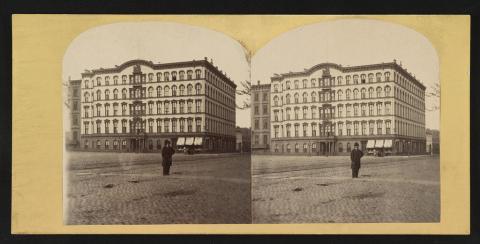
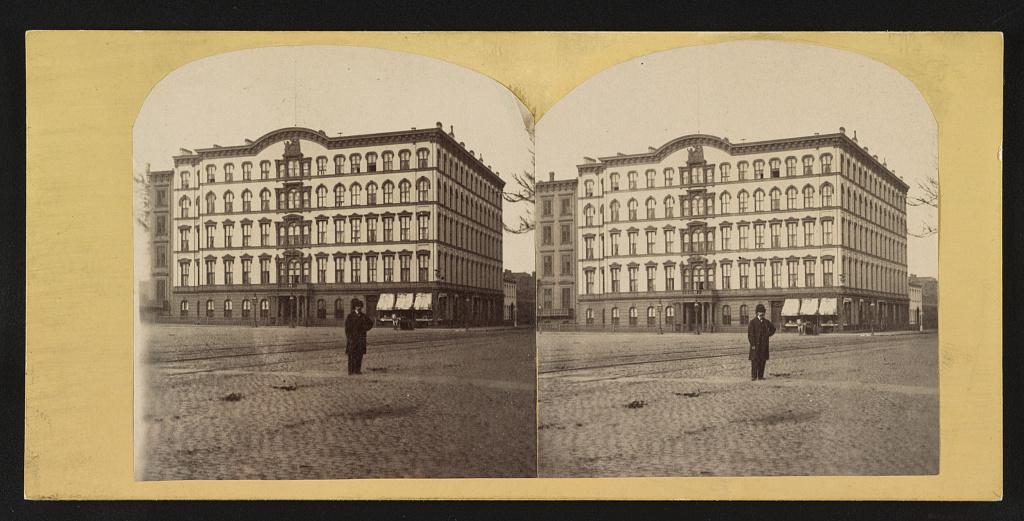
Like his Gramercy Park, Samuel Ruggles's Union Square was an elegant residential enclave with four-story mansions and a park surrounding an iron-fenced park. In 1853 a first-class hotel, the Everett House, appeared among the private residences.
The hotel was five stories tall with four stories of brick sitting on a rusticated stone base. High end shops opened onto the Fourth Avenue (later renamed Park Avenue South) side. Above the columned portico, a stack of grouped, Palladian inspired openings directed the eye upward to a gently arched pediment.
The proprietor, Hawley D. Clapp, named the hotel after "the distinguished Massachusetts Senator," Edward Everett.
The Everett House, like all first-class hotels at the time, provided both transient and permanent accommodations. There were 60 suites, each with "uncommonly high" ceilings of 15 and a half feet. The building was designed with comfort and privacy in mind. On December 23, 1853, the New York Herald noted, "The house is so constructed and arranged that the different suits of rooms are almost as retired and quiet, and free from external disturbance, as separate houses."
The furniture throughout was rosewood and sat upon English velvet carpets. "The curtains of the windows, and the covering of the chairs and sofas, are of costly and beautiful material." The New York Herald reported that "The parlor furniture cost from twelve hundred dollars to seventeen hundred and fifty to a room." That price would be equal to as much as $56,100 per room today. Three of the "enormous mirrors," according to the New-York Tribune, cost $7,500, or nearly a quarter of a million in 2017 dollars.
Along with certain European nobility, the Everett House attracted high level politicians. When Presidential candidate James Buchanan arrived in New York on April 23, 1856, the city had already arranged rooms for him here. And when Senator Stephen A. Douglas arrived with his family on December 28, 1858, representatives of the Common Council met them at the dock to escort them to the Everett House.
Another of the other permanent residents at the time was millionaire Jay Gould, who lived here at least through 1861. The family of Samuel Clemens lived here during the summer of 1869, and two years later two high-profile guests, Mary Todd Lincoln and her son Tad, stayed in the hotel.
The Everett House was the scene of a glittering reception for Civil War General Daniel Edgar Sickles on June 30, 1869. The New York Herald was impressed by the bipartisan (if male-only) outpouring of respect. "Republican and democrat, radical and conservative, men of every stripe and of the highest standing in the community, were present, and had not the Committee of Arrangements decided on confining the reception entirely to gentlemen there is little doubt that the ladies would have mustered in strength and brought fresh accessions of guests to the beautiful parlors of the Everett House."
In the 1860s and '70s, the city's Democratic Party leased rooms in the Everett House for its headquarters. In 1876, the Democratic National Committee had its home here as it campaigned for Governor Samuel J. Tilden for President. Tammany Hall held sway over the New York Democratic organization in the late 19th century, so a particular gathering in the Everett House headquarters on March 1, 1878 was somewhat shocking.
The New York Herald reported "A conference meeting of a committee from the New York county democracy and a committee from what is known as the Everett House anti-Tammany democracy was held last evening at the Everett House, in the same rooms that were occupied in the fall of 1876 by the Democratic National Executive Committee."
In December 1906 the New-York Tribune published rumors that the hotel was on the verge of bankruptcy. The newspaper recalled that "As the centre of the hotel district moved uptown, the Everett House maintained its popularity." Now owned by the Everett House Company, its manager, William H. Parke, scoffed at the rumors, saying "the hotel had been doing a good business" and said it was clearing about $100 per day.
In 1906, other than the recent fire escapes, little had changed to the building since 1853. from the collection of the New York Public Library.
Despite the management's denials, the end of the venerable hotel was near. The building was foreclosed upon in 1907 and bankruptcy was forced upon the owners. On the morning of June 16, 1908, a notice was tacked to the office bulletin board announcing that the building would be torn down to be replaced by a 20-story office building. The New-York Tribune reported "The seventy-five guests, many of whom have been patrons of the hotel for years, looked at one another bewildered."
From the Daytonian in Manhattan