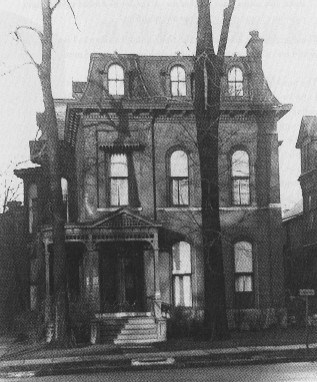
By September 11th of 1869, Sam had changed his mind regarding the lecture circuit and began his "Our Fellow Savages" tour until January 21, 1870. He married February 2, 1870 and was soon living in a mansion on Delaware Avenue.
He seems to have had a change of personality at the time of his move to Buffalo. Money has always preoccupied him, throughout his life and is a common factor in much of his writings. But his move to Buffalo marks a change from a humanistic bent to one of allegiance to big business. See this from Scharnhorst Pages 512-4 The Life of Mark Twain: The Early Years, 1835-1871:
From page 531:
Joe Goodman, who visited the Clemenses in Buffalo in April 1870, was flabbergasted by the changes he witnessed in Sam's behavior since the Virginia City days, particularly his adherence to mid-Victorian standards of bourgeois respectability.
In a letter from Goodman to Paine (date March 13, 1908):
Did I tell you of the time Mark tried to be a Christian, or at least a conformist? I don’t recollect that I did. It will not be available for the “Life” or “Biography,” or whatever you are going to call it, but it’s awful characteristic. I was abroad in the Spring of 1870 when Mark was married, and didn’t see him and his wife till I returned in July and went up to Buffalo to visit them. I arrived just before dinner time, and Mark took me up to my room and showed me a bottle of whiskey on the table, which he had persuaded Livy to place there by telling her it was awful sinful, of course, but that I had lived in sin all my life and she couldn’t expect to reform me except by gradations. We took a pull at the bottle and went down to dinner. I was talking and laughing and running on at about forty knots, when I suddenly observed that there was nothing doing —that everybody seemed to be waiting for me to finish; so I shut up at once. Then Mark bowed his he head and began in a sepulchral voice: “O Lord, for that we are about to receive”—I couldn’t restrain myself, it was so absurd; I just snorted, and Mark finished amid my uncontrollable laughter. Afterwards, by ourselves, I asked him when the change of heart had occurred. “Oh, Hell! There isn’t any change,” he said. “Of course, I don’t believe in it, but Livy does, and I want to do everything I can to please her; so I try to go through with it solemnly and reverently.”
They had moved to Hartford before I saw them again. When we gathered at the table, I sat silent and expectant as a deacon. But, to my surprise, Mark began ladling out the soup without any grace. I brought him to task for it as soon as we were alone. “Oh, damn it, I couldn’t stand it—it was too hypocritical,” he said; “so I told Livy we had better cut it out, and she seemed to think it was just as well.” Perhaps Rev. Joe Twitchell may know something of Mark's reversion to heathenism. Ask him.
Mark Twain is in Buffalo and feels he will no longer need to take to the platform.
To James Redpath
10 May 1870 • Elmira, N.Y.
Friend Redpath,—
I guess I am out of the field permanently. I am sending off these circulars to all lecture applicants now. If you want some more of them I can send them to you—for they are very convenient for you to mail to people save penmanship.
Have got a lovely wife, a lovely house, bewitchingly furnished, a lovely carriage,& a coachman whose style dignity are simply awe-inspiring—nothing less & I am making more money than necessary, by considerable, & therefore why crucify myself nightly on the platform. The subscriber will have to be excused from the present season at least.
Remember me to Nasby, Billings & Fall. Luck to you! I am going to print your menagerie, Parton and all, and make comments.
In next Galaxy I give Nasby’s friend and mine from Philadelphia (John Quill, a literary thief) a “hyste.” I don’t consider that the Rev. Talmage has the weather gage of me yet.
Yours always & after,
Mark.
For a in depth study of Mark Twain's life in Buffalo, NY see Scribblin' For A Livin' by Thomas Reigstad.
It took a series of tragic events to take Sam out of this mindset.
All too soon events, and a dissatisfaction with his situation bring about a change of mind. Olivia became pregnant, but was devastated when her father was diagnosed with stomach cancer and died on Aug. 6, 1870: Emma Nye, a dear friend of Olivia’s who was visiting, was stricken with typhoid fever and died in their home Sept. 29: Finally, their son, Langdon, was born prematurely Nov. 7, frail and sickly, and Olivia fell ill with typhoid herself.
They had had enough. Olivia was carried out of their home on a mattress to the train station for the trip to Elmira. Both the home and Twain’s stake in the Express were sold at a loss.