June 5 Friday – Sam, Livy, and Jean left Hartford for New York, where they met their other daughters and Sue Crane. The party stayed at the Murray Hill Hotel.
New York to France: Gascoigne
June 6 Saturday – At 5 a.m. the Clemenses sailed from New York for France on the Gascoigne. The family would not return for more than eight years and would never again live in Hartford.
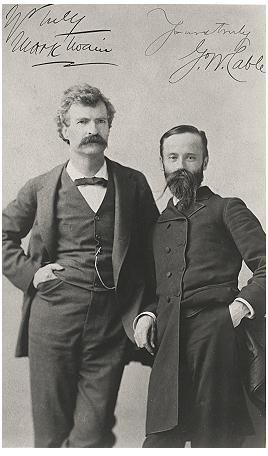
George Washington Cable and Samuel L. Clemens first met in 1881.
AFTER twenty-one years' absence, I felt a very strong desire to see the river again, and the steamboats, and such of the boys as might be left; so I resolved to go out there. I enlisted a poet for company, and a stenographer to 'take him down,' and started westward about the middle of April.
They dallied in Liverpool for two days, and then boarded the newly commissioned Cunard steamer Gallia, “a very fine ship.” Coincidentally, they sailed with Sams friend the Earl of Dunraven, “an uncommonly clever fellow.” During the transatlantic voyage, the body of a passenger who had died en route was packed in ice and stored in a lifeboat, and Sam added a grisly note to this news in his notebook: “the hilarious Passengers sing & laugh & joke under him” as “the melting ice drips on them.” The family landed in New York on September 2 after a tour that had lasted nearly eighteen mont
“We had a comfortable passage, very smooth sea, none of us were sea sick, but crossing the channel is not pleasant at the best,” Livy wrote her mother the next day from the Brunswick House Hotel on Hanover Square in London. ...
They traveled on July 14 to Rotterdam and registered at the Victoria Hotel. Sam was impressed. by the countryside, “so green & lovely, & quiet & pastoral & homelike,’ and, as usual, by the “very pretty & fresh & amiable & intelligent” Dutch damsels. ‘The next day they railed fifty miles to Amsterdam, where they spent two nights at the Hotel Doelen. Sam delighted in Rembrande’s paintings in the Rijksmuseum, especially The Night Watch, and Livy bought “a beautiful etching” of it for twenty dollars to hang in the Hartford house.
In early July Sam hired Joseph N. Verey for two dollars a day to serve as their courier during a hasty tour of the Low Countries.
Munich German city. Midway through the long European trip that Mark Twain undertook in order to write A Tramp Abroad, he and his family stayed in this Bavarian capital from November 15, 1878 through February 27, 1879. Members of the family regarded the Munich months as a pleasant winter rest, during which they busied themselves with studying German and art instruction and enjoyed a Bavarian Christmas, while Mark Twain worked on his book. He did write at least one chapter about Munich, but omitted it from the final manuscript.
August 12, 1878 Monday – The men left Baden Baden by rail and arrived at Lucerne, Switzerland where they joined Livy, the children and the rest of the party who had been there a few days. (See Baden to Lucern)
August 15 Thursday – The entire Clemens party took a two-day excursion to the Rigi-Kulm. They spent the night in a hotel on the Rigi to watch the sunset and sunrise. (See Excursion to the Rigi-Kulm)
Subscribe to
© 2026 Twain's Geography, All rights reserved.